
High-Stakes Governance: Navigating Multi-Vendor PMO Setup in Canada

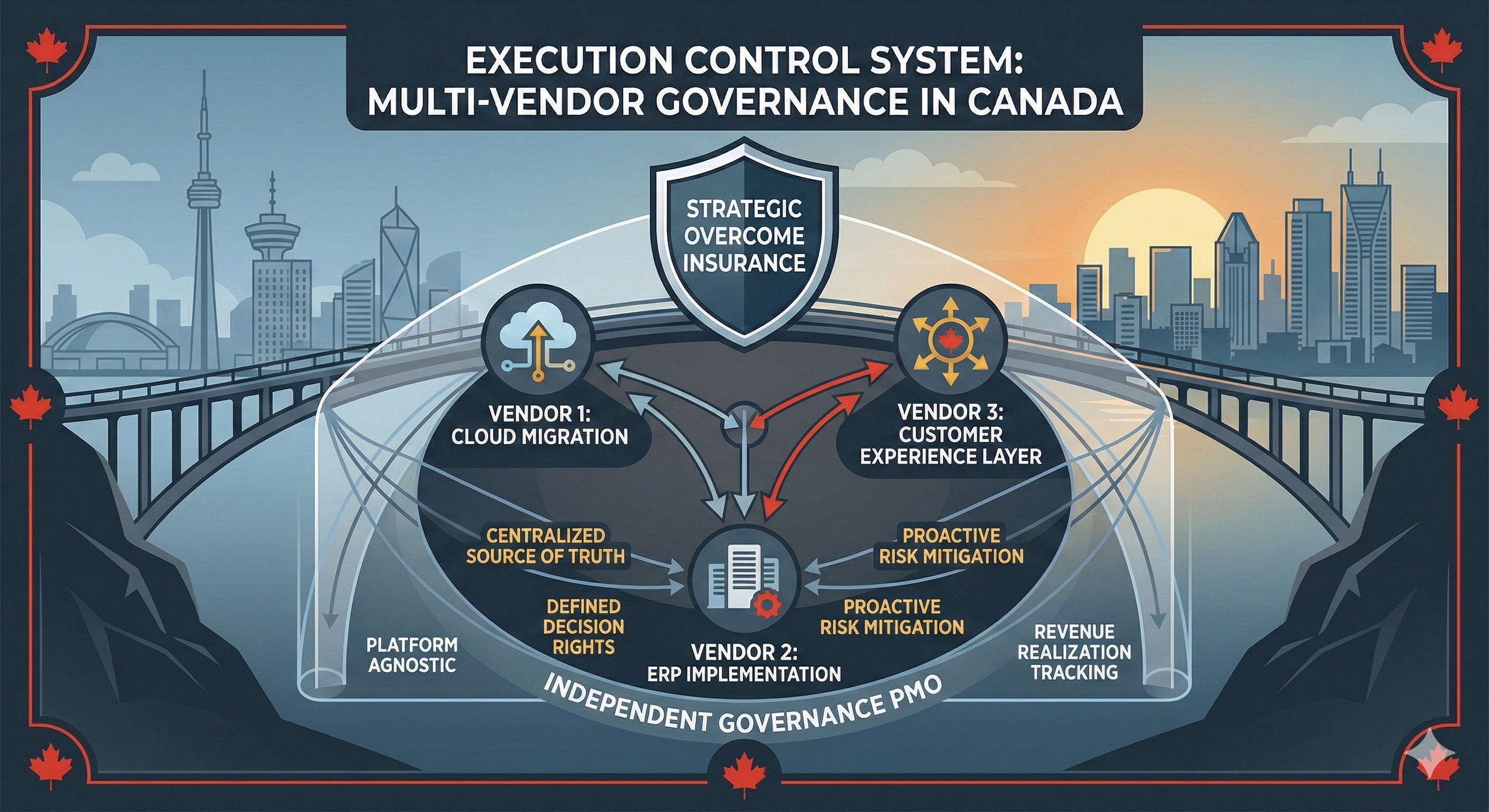
Every mid-market leader in Toronto, Vancouver, or Montreal eventually hits the same wall. You have a vision for digital transformation. You have the capital. You have three different specialized vendors, one for the cloud migration, one for the ERP implementation, and one for the customer experience layer. Yet, six months into the roadmap, the “Execution Gap” is wider than ever. The technical work is happening, but the business value is missing. This friction is rarely a technical failure. It is a governance failure. When you initiate a PMO setup in Canada for a multi-vendor environment, you aren’t just managing tasks; you are managing a complex ecosystem of competing incentives, misaligned timelines, and fragmented accountability.
In the Canadian mid-market, the stakes are uniquely high. You do not have the infinite “consulting spend” of a Big Five bank to absorb two years of delays. You need a lean, surgical approach to oversight that ensures external partners deliver on their promises. Navigating this landscape requires moving beyond administrative project management and toward a robust Execution Control System. This article examines how to architect a governance structure that holds every party accountable and ensures your strategic investments actually reach the balance sheet.
The Illusion of Vendor-Led Governance
Many executives fall into the trap of believing their primary software vendor or system integrator will manage the program for them. This is a fundamental misunderstanding of incentive structures. A vendor’s primary goal is to deploy their specific scope as quickly and profitably as possible. They are not incentivized to point out when their work conflicts with another vendor’s output, nor are they responsible for your overall business readiness. When you rely on a vendor to grade their own homework, you lose the “Execution Control” necessary to protect your investment.
A professional PMO setup in Canada must be platform-agnostic to be effective. It needs to act as a neutral arbiter that focuses exclusively on your corporate outcomes. This independent layer ensures that when a conflict arises between two technical partners, the resolution is based on what is best for your organization, not what is easiest for the vendors. By establishing this oversight early, you prevent the finger-pointing that typically occurs when a complex program begins to stall.
Architecting the Execution Control System
Effective governance in a multi-vendor environment requires a centralized “source of truth.” Without it, each vendor reports their own version of progress using their own metrics. This fragmentation creates a fog of war for the executive team. The PMO’s job is to consolidate these disparate streams into a single, high-fidelity view of the program’s health. This is not about producing more status reports; it is about providing the data necessary to make rapid, high-stakes decisions.
Building this system involves defining clear decision rights before the first line of code is written. You must know who has the authority to approve a change in scope, who owns the budget for inter-vendor dependencies, and who is responsible for final user acceptance. A well-executed PMO setup in Canada provides the framework for these interactions, ensuring that your internal teams are not overwhelmed by the administrative burden of managing multiple external contracts. Instead, your leaders stay focused on the strategic goals while the governance layer handles the operational friction.
Managing Dependency and Delivery Risk
In a multi-vendor landscape, the greatest risks live in the “white space” between contracts. Vendor A might be waiting for an API from Vendor B, while Vendor C is stalled because the internal data team hasn’t been briefed. These dependencies are where transformation budgets go to die. Traditional project management often misses these gaps because each individual vendor is only looking at their own silo. Your governance layer must be obsessed with these intersections, proactively identifying risks before they turn into delays.
We call this approach Outcome Insurance. By focusing on the flow of value across the entire program, the PMO identifies “Delivery Risk” early. This involves rigorous pressure-testing of vendor timelines and ensuring that “done” truly means the solution is ready for the business to use. In the Canadian context, where specialized talent is often shared across multiple firms, having a firm grip on these dependencies is the only way to maintain your delivery velocity.
From Status Updates to Revenue Realization
The ultimate measure of a program is not whether it launched, but whether it achieved the financial goals set out in the original business case. Most PMOs stop at the launch date. An elite governance structure continues through the adoption phase to ensure Revenue Realization. This shift in perspective changes how you manage vendors. You are no longer just paying for deliverables; you are paying for results.
If a project is technically complete but the business hasn’t realized the promised efficiencies, the program has failed. A strategic PMO setup in Canada incorporates value-tracking into the very core of its operations. This means monitoring adoption rates, process improvements, and cost savings long after the vendors have moved on to their next client. This ensures that the organization gets what it paid for and that the transformation actually sticks.
Comparison of Governance Models
Most organizations choose between two governance models. Neither works. Vendor-led management puts loyalty to the vendor’s margin above the business case. Vendors track contractual deliverables, respond defensively to scope challenges, and report their own metrics. There is no independent source of truth. A traditional internal PMO is better, but not by much. It tracks task completion against project schedules, moves slowly through bureaucratic escalation channels, and fragments data across spreadsheets. Neither model is designed to answer the question that matters: is the ROI in the original business case being realized?
The Execution Control System operates from a different set of rules. Primary loyalty goes to the business outcome, not the vendor’s margin or the project schedule. Conflict resolution is decisive and objective because the governing party has no implementation agenda. The focus area is Revenue Realization, not task completion. Delivery Risk is identified and addressed before it compounds. And a centralized source of truth replaces the fragmented, self-reported metrics that allow governance gaps to go undetected until it is too late.
This is not a process improvement. It is a fundamentally different accountability structure.
Successfully navigating a PMO setup in Canada is the difference between a transformation that changes the trajectory of a company and one that just becomes an expensive lesson. By implementing a high-stakes governance model, you reclaim control over your external partners and ensure your strategy survives the reality of execution. This commitment to operational excellence is what defines the market leaders of the next decade.
Because strategy is a theory. Delivery is the reality
Read the full article here
.